Cupping uses gentle suction to lift tight muscles and bring fresh blood into them. At our Financial District office, a 30-minute dry cupping session is a focused reset for the tension that builds up over long desk hours and crowded commutes.
What is dry cupping good for? Most people come in for muscle tension that has not let go with rest alone: a stiff neck, a sore back, knots between the shoulder blades, or soreness after training or a physically hard week.
Your acupuncturist asks where you hold tension, looks at the skin in that area and decides whether fixed cups, sliding cups or both suit you best.

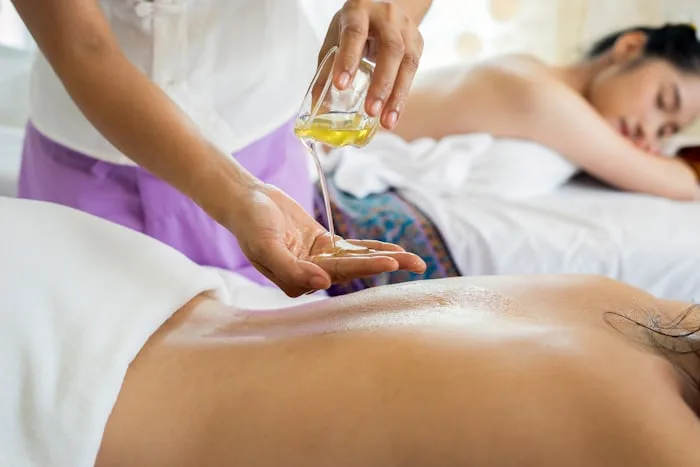
You lie face down on the treatment table, and a light oil is applied so the cups seal well and glide smoothly.

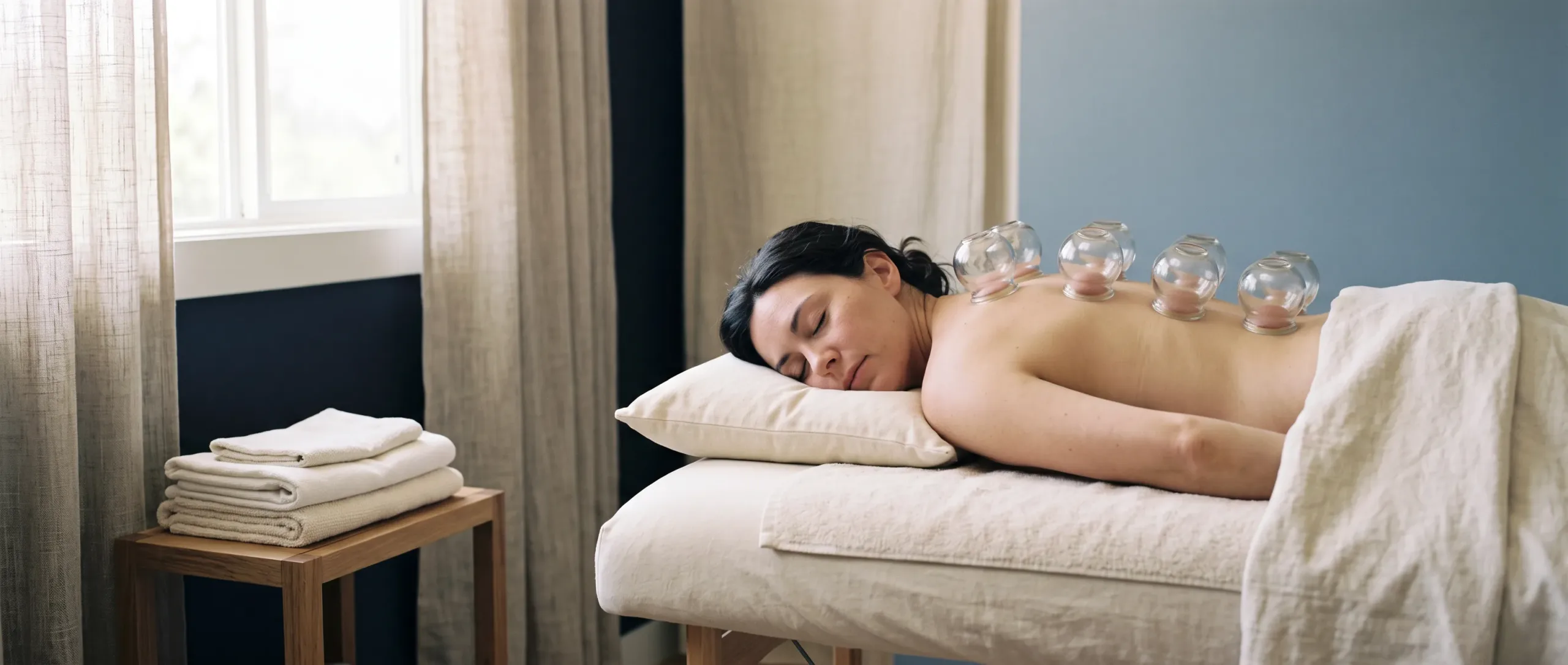
Cups are set along the tight bands of muscle, most often across the upper back, between the shoulder blades and on either side of the spine, never on the spine itself.

Fixed cups stay in place for five to fifteen minutes. With sliding cupping, one or two cups move slowly and steadily along the muscle; many sessions use both, depending on where the tension sits.

The cups are released, the oil is wiped off, and you rest for a few minutes before getting up. The whole session takes about 30 minutes, and you can book your next visit online.

Cupping therapy uses glass or silicone cups placed on the skin. Some of the air inside each cup is drawn out, and the suction gently lifts the skin and the muscle beneath it into the cup. Instead of pressing down, like a massage, cupping pulls up.
The lift is thought to loosen the fascia, the thin layer wrapped around each muscle, and to bring more blood to the area. Many people say a tight spot feels softer and moves more freely afterward. Research on cupping is ongoing, and responses vary from person to person.
We use dry cupping only. Cups either stay in place for five to fifteen minutes (fixed cupping) or glide slowly across oiled skin (sliding cupping); many sessions use both, depending on where the tension sits.

Most people describe cupping as a firm, warm pull rather than pressure. It should not be painful, though the pull feels stronger over an especially tight spot, and some people notice a brief sting as a cup first takes hold. Many find the session relaxing and feel loose and pleasantly tired afterward.
Round marks appear where the cups sat. They are not bruises from a knock: they form because suction draws blood up toward the skin. Their color ranges from light pink to deep red or purple and differs from person to person and from one area to another. The marks are painless and usually fade within three to five days, occasionally up to two weeks.
Blue Iris is our acupuncture practice near Wall Street, at 139 Fulton Street, Suite 136, two minutes from the Fulton St station; here are walking directions from Fulton St station. Sessions are Monday to Friday, by appointment.


Cupping is usually avoided during pregnancy; ask about other options.
Tell Irina when you book; she may ask you to check with your doctor first.
Open wounds, burns, eczema, varicose veins or large raised moles: the cups go elsewhere, or the session waits.
Cancer, an infection with a fever, high blood pressure that is not well controlled, a pacemaker or severe exhaustion: check with your doctor first.

Safety
Cupping is generally considered safe when it is done by a trained practitioner. The most common side effect is the round marks; some people feel tired or slightly lightheaded for a short while afterward.
Cupping does not diagnose or replace medical care. If a problem is new, getting worse or unexplained, see your doctor first.
At our office, a 30-minute cupping session is $70. Added to a 50-minute acupuncture visit ($110), the two are billed separately, so the visit comes to $180.
Cupping also pairs naturally with other treatments in one visit. With a 50-minute acupuncture visit, the needles work on broader patterns of pain and tension while the cups give a concentrated release to one area. Gua sha with a smooth-edged tool covers similar ground, the neck, shoulders and upper back, by pressing along the muscle instead of lifting it, and some people alternate the two. Moxibustion when cold makes muscles stiff adds gentle warmth to the same areas.
How many sessions you need depends on how long the tension has been there and how your body responds. Irina suggests a plan at your first visit and confirms the pricing with no obligation, so you know the commitment before you start.
We are out of network and do not bill insurance plans, so visits are paid at the time of care. If you are comparing the cost of cupping therapy in NYC, the prices below are exactly what you pay per session.
Good to know
A 30-minute dry cupping session at our office is $70. It pairs well with a 50-minute acupuncture visit ($110); when combined, each treatment is billed separately. We are out of network, and visits are paid at the time of care.
Cupping is widely used for back, neck and shoulder tension, especially the stiffness that comes from long hours at a desk. The suction is thought to loosen tight tissue and bring more blood to the area, and many people feel looser after a session. Research is ongoing, and results vary.
It should not. Most people feel a firm, warm pull, a little stronger over the tightest spots, and sometimes a brief sting as a cup takes hold. Tell your acupuncturist if the pull feels too strong, and the suction can be eased.
The main one is the round marks. They are painless but visible, and they usually fade within three to five days, occasionally up to two weeks. Some people feel tired afterward. Cupping is also not right for everyone; the list above shows when to check with a doctor first.
Usually three to five days, sometimes up to two weeks. The color varies from light pink to deep red or purple and is often darker where the muscle was tightest. If you have an event coming up, tell your acupuncturist, and she can work around areas that will show.
They work differently rather than one being better. Massage presses down into the muscle; cupping lifts it, which many people find helpful for stubborn knots and tight bands. Some people use both, and cupping can be added to an acupuncture visit at our office.
It depends on how long the tension has been there. People with a recent flare-up sometimes come weekly for a few visits, then less often as things ease. Irina suggests a schedule at your first session and adjusts it as you go.
No. We offer dry cupping only, with fixed cups and sliding cups over oiled skin. Wet cupping and hijama involve breaking the skin and are a different practice.
Our office is at 139 Fulton Street, Suite 136, New York, NY 10038, two minutes on foot from the Fulton St station (A, C, J, Z, 2, 3, 4, 5), with WTC / Cortlandt (E, R, W) and the PATH just west. The Seaport is about five minutes away, and Battery Park City, Tribeca and the Civic Center are within a ten-minute walk; several parking garages sit within a block, on Fulton, Ann and Gold Streets. Sessions are Monday to Friday, by appointment.