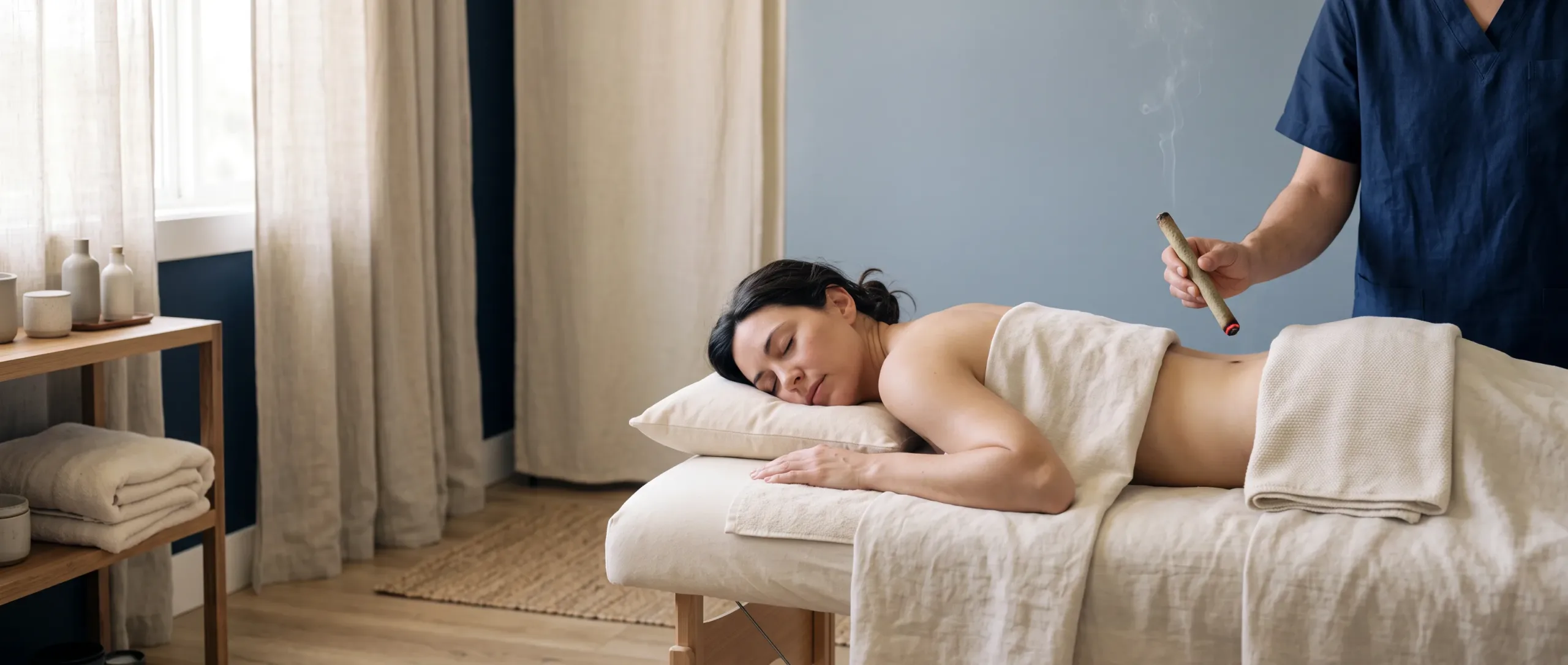
Moxibustion warms chosen acupuncture points with the slow, steady heat of a smoldering mugwort stick held just above the skin. At our Financial District office, a 30-minute session is a gentle, deeply relaxing treatment, on its own or with acupuncture.
What is moxibustion good for? It is chosen when the body seems to need warming, when circulation feels slow, or when muscles and joints are stiff and achy: chronic back or neck pain, muscle spasms, headaches linked to the upper back, cramps that feel worse with cold, or restless sleep.
You settle into a comfortable position, usually lying down, in loose clothing that moves aside easily. Point out the areas that feel cold, achy or tense.

Irina chooses the points for your main concern, based on what you describe and, at your first visit, on pulse and tongue reading.

A smoldering mugwort stick is held about half an inch to an inch above each point. You feel a pleasant, spreading warmth, and the distance is adjusted all the time so the heat stays comfortable.

Several points are warmed in turn, two to five minutes each, or one area receives steady warmth for up to fifteen or twenty minutes, depending on the technique. The room is well ventilated.

When the warming is complete, the treated areas may be covered for a moment to hold the heat, and you rest briefly before getting up. You can book your next visit online.

Moxibustion is one of the oldest techniques in East Asian medicine and is often used alongside acupuncture. A stick of dried mugwort, called moxa, smolders slowly, and its glowing tip is held about half an inch to an inch above an acupuncture point, so the skin feels a steady, penetrating warmth but never touches the heat.
The warmth is thought to increase local blood flow, ease muscle spasm and help the body relax. Where acupuncture moves and directs, moxibustion is described as warming and replenishing. Research on moxibustion is ongoing, and responses vary from person to person.
The stick may sweep slowly over a broad area, peck toward one point after another, or stay over a single point until a deep warmth builds; your acupuncturist chooses the approach for your concern.

Most people describe a deep, pleasant warmth that slowly spreads through the area. A light pinkness of the skin is normal and fades within an hour or so. Smoldering mugwort has a mild, earthy, herbal smell that some people find calming in itself, and the room is well ventilated.
Afterward it is common to feel relaxed or a little drowsy, and some people sleep better that night. The treated area may stay warm for a few hours, a normal response that passes on its own. Many people book moxibustion in the colder months; here is how the seasons shape acupuncture care.
Moxibustion is offered at our Lower Manhattan acupuncture office, 139 Fulton Street, Suite 136, two minutes from the Fulton St station; see getting here by subway or car. Sessions are Monday to Friday, by appointment.


Warming is not right when the body is already running hot; wait until you have recovered.
Talk to your obstetrician before moxibustion.
Check with your doctor first, especially if the area to be warmed is affected.
Broken or inflamed skin at the site, a pacemaker or another implanted device, or an allergy to mugwort or smoke: tell Irina before the session.

Safety
Moxibustion is generally considered safe when it is done by a trained practitioner. The stick never touches the skin, and the distance is adjusted constantly so the warmth stays comfortable; a light pinkness that fades within an hour is normal.
If you are sensitive to smoke or strong scents, say so when you book: a smokeless mugwort stick can be used instead.
At our office, a 30-minute moxibustion session is $70. Added to a 50-minute acupuncture visit ($110), the two are billed separately.
Moxibustion pairs naturally with acupuncture, which directs the treatment: the needles do the directing, while the warmth deepens circulation and eases cold, stubborn tension. It also suits cupping for stiff, cold muscles and gua sha, since warmth beforehand helps loosen tissue and makes the hands-on work more comfortable.
How many sessions you need, and how often, depends on your concern and how your body responds. Irina outlines a plan after the first session and confirms the pricing with no obligation.
We are out of network and do not bill insurance plans, so visits are paid at the time of care. If you are comparing the cost of moxibustion in NYC, the prices below are exactly what you pay per session.
Good to know
No. The mugwort stick is held above the skin and never touches it. You feel a pleasant, spreading warmth, and the distance is adjusted constantly so the heat stays comfortable. Most people find it deeply relaxing.
Smoldering mugwort smells mild, earthy and slightly bitter, a little like sage. Some people enjoy the scent; others find it strong. The room is well ventilated, and a smokeless stick can be used if you prefer.
A 30-minute session at our office is $70. Added to a 50-minute acupuncture visit, the two are billed separately, $70 and $110. We are out of network and do not bill insurance.
Many people feel warmer, looser and calmer after a session, and some sleep better that night. The warmth is thought to increase local blood flow and ease muscle spasm; research on moxibustion is ongoing, and how much it helps varies from person to person.
It depends on your concern and how your body responds. Irina outlines a plan after the first session, often alongside acupuncture, and adjusts it as you go.
Skip it or check with a doctor first if you have a fever or an active infection, are pregnant, take blood thinners, have varicose veins or a history of blood clots in the area, have broken or inflamed skin at the site, or are allergic to mugwort or smoke.
Yes, they are often combined. Acupuncture directs the treatment through the needles, while moxibustion adds warmth to chosen points. Each is billed separately.
Smoke sensitivity is common, and the room is kept well ventilated. Mention it when you book, and a smokeless mugwort stick can be used instead.
Our office is at 139 Fulton Street, Suite 136, New York, NY 10038, a two-minute walk from the Fulton St station (A, C, J, Z, 2, 3, 4, 5), with WTC / Cortlandt (E, R, W) and the PATH just west. The Seaport, Battery Park City, Tribeca and the Civic Center are each within a ten-minute walk, and several garages sit within a block on Fulton, Ann and Gold Streets. Sessions are Monday to Friday, by appointment.


