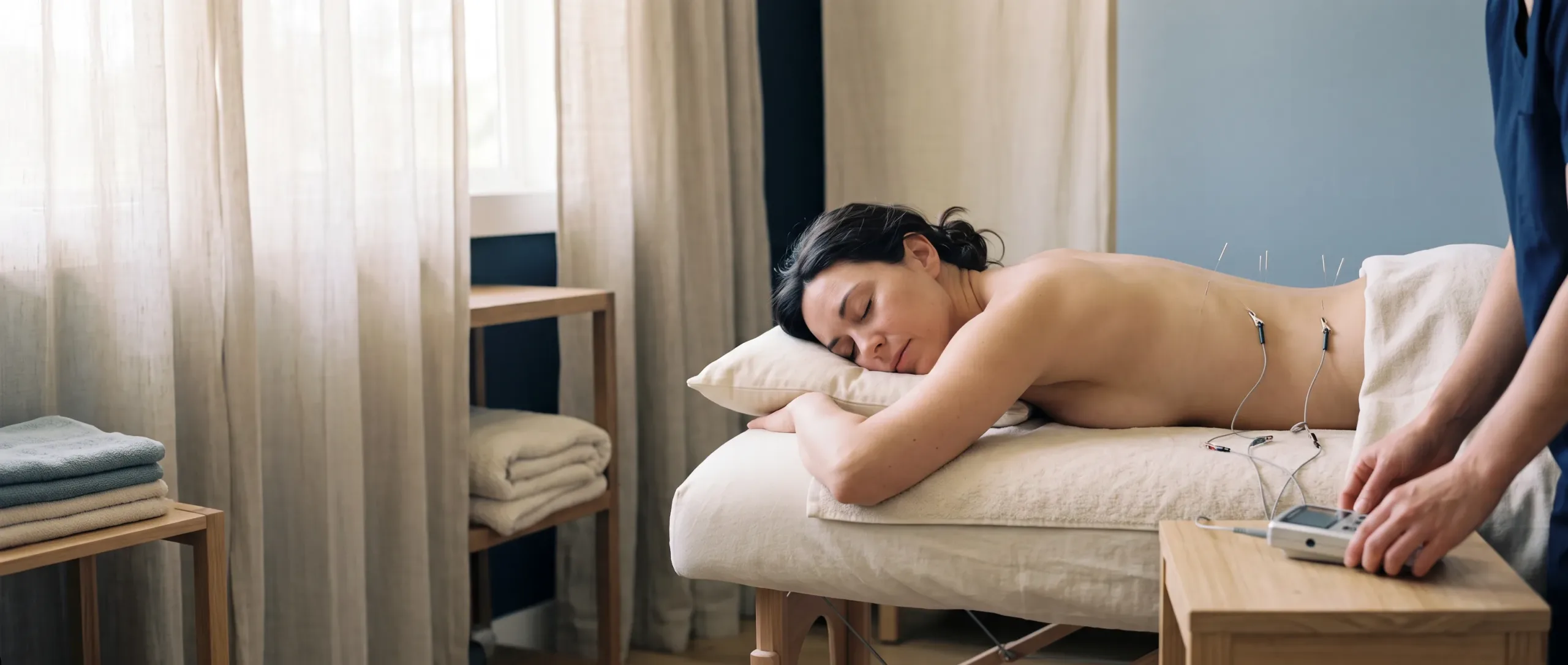
Electro-acupuncture adds a gentle, steady current to fine acupuncture needles. At our Financial District office, a 50-minute session is often chosen for stubborn pain and tight muscles that have not eased with needles alone.
What is electro acupuncture used for? It is often chosen when pain or tight muscles have not shifted with needles alone: aching joints and arthritis, sciatica and pinched nerves, a frozen shoulder, or a slow recovery after an injury, surgery or a hard training block.
Every visit starts with a short conversation about where the pain or tension sits and how it has changed. At your first appointment, Irina also reviews your health history and reads your pulse and tongue.

You settle on the treatment table, the skin is cleaned, and fine, sterile, single-use needles go in at the chosen points: the same needles used in standard acupuncture.

Small clips from the device are attached to pairs of needles, and the current is turned up slowly until you feel a light tap, a soft buzz or a small twitch of the muscle, never anything sharp.

You rest with the needles and the current on for 20 to 30 minutes. Many people find the steady pulse calming and doze off. Irina checks on you and adjusts the settings if needed.

The device is switched off, the clips and needles are removed, and you sit up when you are ready. Before you go, you and Irina agree on the next visit.

Electro-acupuncture, also written electroacupuncture, starts like a standard acupuncture session: fine, sterile needles are placed at chosen points. Then small clips are attached to pairs of needles, and a small device sends a mild, steady current between them.
The current gives a steadier stimulus than turning the needles by hand. It is thought to boost the release of endorphins, the body's natural pain relievers, and to increase blood flow around the area being treated. Research is ongoing, and responses vary from person to person.
The type of current, its rhythm and its strength are chosen for your concern and adjusted during the session, always at a level that feels comfortable.

Most people feel a light tingling, a gentle tapping or mild warmth around the needles. A small, involuntary twitch of the nearby muscle is normal: it is part of the stimulation. The current starts soft and is set to a level that feels comfortable, and many people find the rhythm calming.
Side effects are uncommon. Some people feel tired, slightly heavy-headed or sleep differently for a few hours afterward; if that happens, the next session is shorter or gentler. A tender spot in the treated area occasionally flares for a day or two and then settles.
Electro-acupuncture is offered at our acupuncture clinic on Fulton Street, two minutes from the Fulton St station; see how to reach Suite 136. Sessions are Monday to Friday, by appointment.


Electro-acupuncture is not done with a pacemaker or another implanted electrical device; standard acupuncture may still be an option.
Tell Irina before your first session; the current may not be right for you.
Check with your doctor first; electro-acupuncture is usually avoided.
Blood thinners, a fever, damaged skin where the needles would go, or a recent heart attack: check with your doctor first.

Safety
Electro-acupuncture is considered safe when it is done by a licensed practitioner with sterile needles and a device made for it. The current is low and is always kept at a level that feels comfortable.
It does not replace medical care. See a doctor first for sudden, severe pain after an injury or a fall, numbness or weakness spreading down an arm or a leg, pain with a fever or unexplained weight loss, or symptoms that are getting sharply worse.
At our office, a 50-minute electro-acupuncture session is $110, the same as a standard acupuncture visit. Other treatments added in the same visit are billed separately.
Electro-acupuncture combines well with other treatments: cupping to loosen tight muscles first can come before the needles, warming moxibustion for chronic stiffness can be added to an area that stays stiff, and gua sha for the upper back can follow.
How many sessions you need depends on the problem and how your body responds: some people notice a change after two or three visits, while long-standing pain usually takes longer. Irina suggests a plan at your first visit and confirms the pricing with no obligation.
We are out of network and do not bill insurance plans, so visits are paid at the time of care. If you are comparing the cost of electro-acupuncture in NYC, the prices below are exactly what you pay per session.
Good to know
Electro-acupuncture is thought to increase the release of endorphins, the body's own pain relievers, and to improve blood flow where it hurts. Research on it is ongoing. Many people notice less pain over a series of sessions, though results vary by condition and person.
A 50-minute session at our office is $110, the same as a standard acupuncture visit. We are out of network, visits are paid at the time of care, and other treatments added in the same visit are billed separately.
The needles and the points are the same. In electro-acupuncture, small clips connect pairs of needles to a device that sends a mild current between them, giving a steadier, stronger stimulus than turning the needles by hand. For the background, read how needling may ease pain.
Most people describe a light tapping, a soft buzz or mild warmth at the needles. The current starts low and goes up only to a level you find comfortable, and a small muscle twitch near the needles is normal.
It depends on the problem and how your body responds. Some people notice a change after two or three sessions; long-standing pain usually takes longer. Irina suggests a plan at your first visit and adjusts it as you go.
Visits are usually closer together at the start and spaced out as things improve. Irina sets the schedule at your first visit and changes it as your body responds.
No. A pacemaker or any other implanted electrical device rules out electro-acupuncture, because the current could interfere with the device. Standard acupuncture without a current may still be an option; ask your doctor and Irina.
It is commonly used after injuries and hard training to ease muscle tension and soreness. Runners and other athletes often combine it with standard acupuncture or cupping as part of a longer recovery plan.
Our office is at 139 Fulton Street, Suite 136, New York, NY 10038, two minutes on foot from the Fulton St station (A, C, J, Z, 2, 3, 4, 5), with WTC / Cortlandt (E, R, W) and the PATH just west. The Seaport, Battery Park City, Tribeca and the Civic Center are within a ten-minute walk; several parking garages sit within a block, on Fulton, Ann and Gold Streets. Sessions are Monday to Friday, by appointment.


